


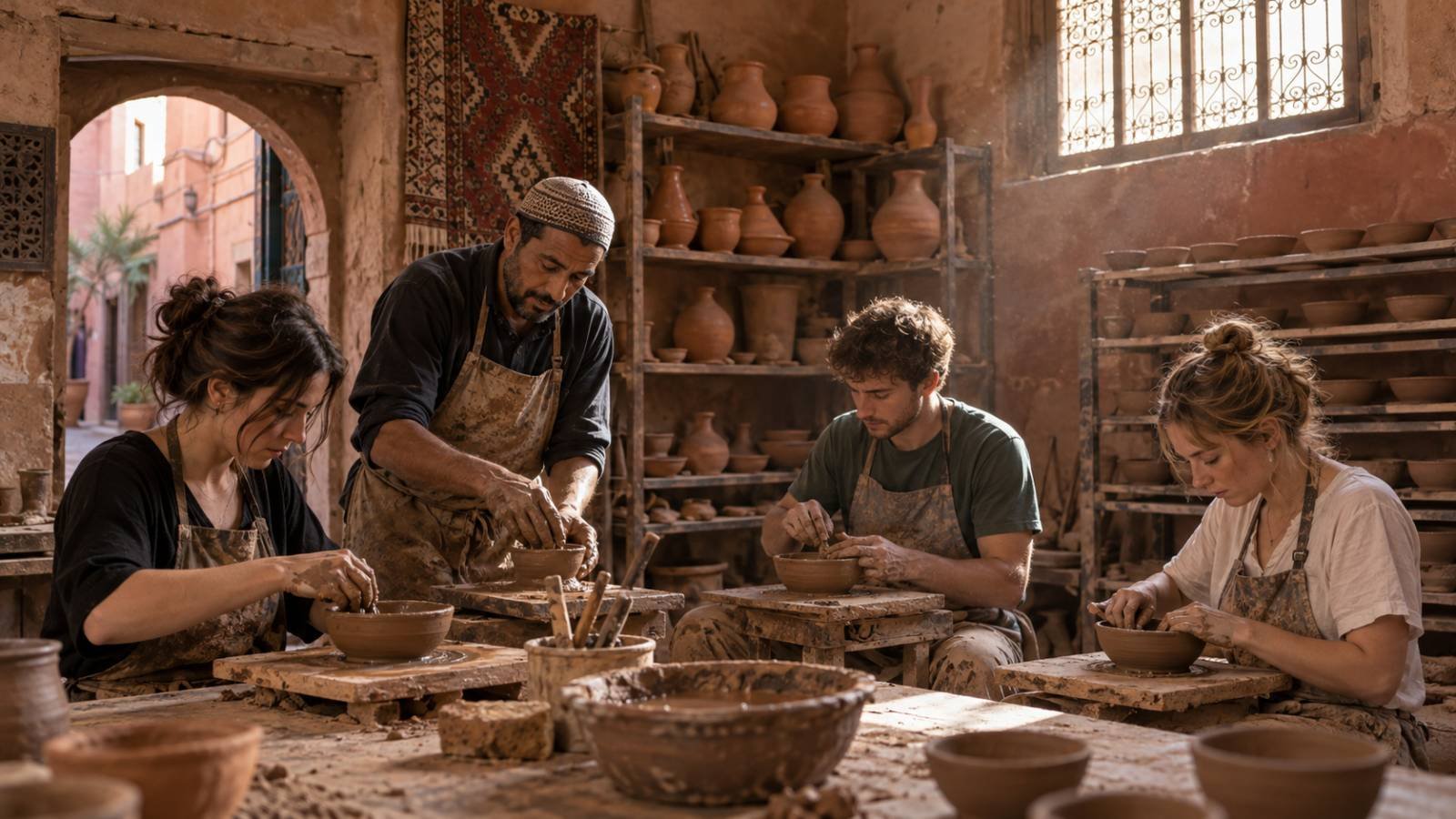

Most travelers arrive in the red city with a camera and a checklist. Then someone hands them a lump of clay, a strip of leather, or a pot of simmering tagine, and something quietly rewires. This is the honest before-and-after of a Marrakech Workshop: not a marketing promise, but the specific, observable shifts that happen between walking in as a spectator and walking out as a participant.
Before You Book: The Tourist Version of Moroccan Craft
Before any Marrakech Workshop, the medina’s crafts exist mostly as photographs. You admire zellige tiles on a fountain, run a finger over a leather babouche on a stall, and photograph a potter’s wheel from a respectful distance. Everything is beautiful, everything is finished, and everything belongs to someone else.
That distance has a cost. You leave with images and very little understanding. Ask yourself honestly: how much do you remember about the last artisan demo you watched? Usually the answer is a shape and a smell, nothing more.
After the First Hour: What Actually Changes
Your hands learn what your eyes missed
Within sixty minutes of a pottery or zellige session, the fantasy collapses in the best way. Clay is heavier and colder than it looks. Centering it requires more patience than strength. You discover that the artisan’s calm is not mysticism but years of repetition compressed into a movement you cannot yet copy.
Time behaves differently
Before, an afternoon in Marrakech was a schedule of sights. After, it becomes a single task. You look up and two hours have gone, and nobody is bored. That is the first real change: the city stops being a backdrop and becomes a room you are working in.
The Before and After of the Souk Walk
This is where the transformation gets practical. The day after a hands-on session, the souk reads differently. A stall of hand-cut leather no longer looks like merchandise; it looks like a sequence of decisions — which hide, which cut, which stitch, how many hours.
- Before: you bargain by price alone, guessing at value.
- After: you bargain knowing roughly how long a piece took, and the conversation changes tone.
- Before: every workshop looks the same from the doorway.
- After: you can tell a rushed tourist demo from a genuine teaching session in about thirty seconds.
- Before: souvenirs are objects.
- After: they are evidence — of a technique you attempted, badly, and now respect.
If you want to skip the guesswork entirely, a well-organized Marrakech Workshop pairs you with working artisans rather than performers, which is the difference between a memory and a lesson.
What Changes in the Food, the Rug, the Leather
Cooking is the most vivid before-and-after. Before the class, tagine is a dish you order. After, it is a stack of small decisions: how much salt the preserved lemon already carries, why the meat goes in cold, why the lid stays on. You will taste the difference for the rest of the trip, and probably cook it at home.
Rug weaving and leather work follow the same pattern. The loom’s geometry stops being decorative and becomes arithmetic. The tannery’s smell stops being a nuisance and becomes a stage in a process. None of this requires talent. It requires showing up with your sleeves already rolled.
The Honest After: What Does Not Change
Let us be fair to reality. A single session will not make you a potter. Your first bowl will lean. Your zellige piece will not be square. You will still get lost in the medina the next morning, and the heat will still win at midday.
What changes is your relationship to the people doing the work. You stop seeing craft as heritage on display and start seeing it as labor, skill, and choice — which is also why choosing the right session matters. A short, curated hands-on Marrakech Workshop beats a long, vague one every time.
The Practical Before Checklist
- Book the technique you are curious about, not the one with the best photos.
- Ask how many people share one teacher.
- Wear clothes you do not mind staining, and skip the rings.
- Choose a morning slot if you want focus; choose late afternoon if you want cooler light.
- Bring cash for the artisan’s own work, which is often better than anything in the shops.
Conclusion: The Only Souvenir That Lasts
The before-and-after of a Marrakech Workshop is simple to describe and hard to fake. Before, you photograph other people’s skill. After, you carry a small, imperfect object you made yourself, and a much larger understanding of how the red city actually works. That is the change worth traveling for — and it starts the moment you stop watching.
#MarrakechWorkshop #ThingsToDoInMarrakech #MoroccanCrafts #CulturalExperiencesMarrakech #LocalArtisans #AuthenticTravel #MarrakechInsider #TravelWithPurpose
0 Comment