


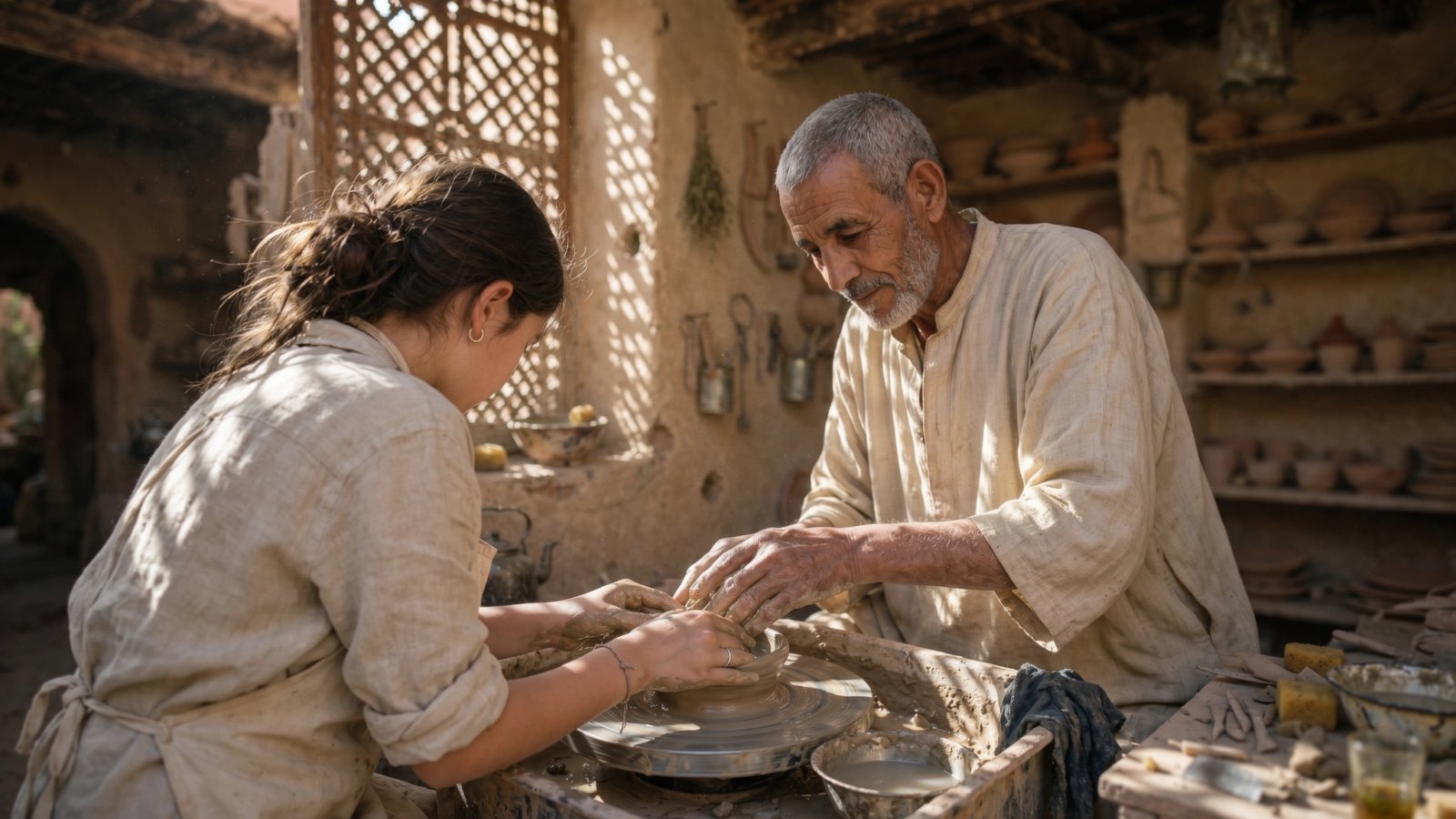

Something is quietly changing in the workshops of the red city. Travelers no longer arrive simply to watch a demonstration and leave with a souvenir. Instead, they want to sit at the bench and get clay under their fingernails. That shift is reshaping the entire Marrakech Workshop landscape. It reaches from the pottery courtyards of the medina to the weaving ateliers behind the souks. This is not a passing fashion. It is a structural evolution in how visitors relate to Moroccan craft.
From Spectacle to Participation: The Core Shift
The old model was comfortable for everyone. A group of twenty filed into a workshop and watched a master artisan for forty minutes. Then they took photos and bought a plate. The new model is smaller and far slower. Moreover, it demands real effort from both sides. Artisans now design sessions around genuine practice. You knead the clay, you throw the shuttle, and you burn your first tagine.
Three forces drive this change:
- Traveler expectations — people want to leave with a skill.
- Artisan economics — teaching now provides a stable income alongside production.
- Word of mouth — strong sessions spread fast, and weak ones fade.
As a result, a Marrakech Workshop today rarely hosts twenty people. Most cap attendance at six or eight.
How the Marrakech Workshop Market Is Evolving
Across the medina, several formats are clearly gaining ground. Others are losing it. The pattern is consistent from studio to studio.
Rising: half-day immersion sessions
Two to four hours is becoming the sweet spot. That window is long enough to finish something real, such as a small zellige tile or a leather pouch. Meanwhile, it stays short enough to fit a rich itinerary. These sessions usually include tea and a short explanation of materials.
Rising: artisan-led micro-groups
Small groups mean real attention. Guests often say the difference between good and great is the ratio of hands to teachers. Consequently, providers now advertise group size openly.
Declining: large demo-and-shop stops
The classic coach-tour workshop stop is losing appeal. Travelers increasingly spot the gap between a staged demonstration and a genuine lesson.
Emerging: family and mixed-generation formats
Workshops for parents and children together are appearing more often. These sessions keep attention spans in mind and use simpler materials. Even so, they still produce something beautiful.
Inside the Medina: Where the Change Is Most Visible
Walk through the lanes near Jemaa el-Fna and you can feel the shift. Pottery studios that once sold only finished pieces now advertise hands-on slots. Zellige workshops explain the geometry before handing over the chisel. Likewise, leather tanners have opened small teaching corners for simple stitching.
The medina rewards those who slow down. A workshop is no longer an interruption in a sightseeing day. Instead, it has become the anchor of the day. The souks are then explored around it rather than the other way round. If you want to see how this fits a wider itinerary, these hands-on cultural experiences in Marrakech show what is currently on offer.
What This Means for Your Booking Decisions
The market evolution has a direct consequence. Choosing well matters more than ever, because the range of quality has widened. Therefore, ask a few sharp questions before you commit.
- Ask about group size. Anything above ten people deserves a hard question about attention.
- Ask what you will physically make. A vague answer is a warning sign.
- Ask who teaches. Artisan-led is different from guide-led.
- Ask about materials. Real clay and wool matter, so check for substitutes.
- Ask about language. Good sessions handle instruction clearly across languages.
None of this requires suspicion. It simply reflects a market where the best providers answer these questions proudly. The weakest ones do not.
The Wider Trend: Craft as Cultural Exchange
Behind the formats sits a bigger idea. Craft tourism is moving away from extraction and toward exchange. That means time, attention, curiosity, and respect. Artisans increasingly describe teaching as a way of keeping traditions alive. They are not merely monetizing them. Meanwhile, visitors arrive wanting exactly that exchange.
This is why the most memorable sessions feel like an afternoon with a lifelong practitioner. They feel less like a class. The object you make is almost secondary to the conversation around it.
Conclusion: Book for the Experience, Not the Souvenir
The Marrakech Workshop market is maturing quickly. Smaller groups and artisan-led teaching are replacing the old formula. Above all, a genuine emphasis on participation now sets the tone. For travelers, the opportunity is simple. Choose a session that asks something of you, and you will leave with far more than an object. The city’s crafts are evolving, and the best way to understand that evolution is to take part.
#MarrakechWorkshop #MoroccanCrafts #CulturalExperiencesMarrakech #HandsOnMarrakech #MarrakechArtisans #AuthenticTravel #MoroccoPlan #CraftWorkshopMarrakech
0 Comment