



How to Pick a Marrakech Workshop Without Wasting Your Afternoon
Booking a Marrakech Workshop looks simple: pick a craft, pick a time, pay, show up. In practice, the difference between a memorable afternoon and a forgettable one rarely comes down to the craft itself. It comes down to how you choose. Somewhere in the medina there is a pottery wheel waiting for you, a tagine class with too many people in it, and a zellige table where nobody explains what the shapes mean. This guide is about the decisions you make before you book, and the small warning signs that separate a real hands-on experience from a photo opportunity with a price tag.
Why the Choice of Marrakech Workshop Matters More Than the Craft
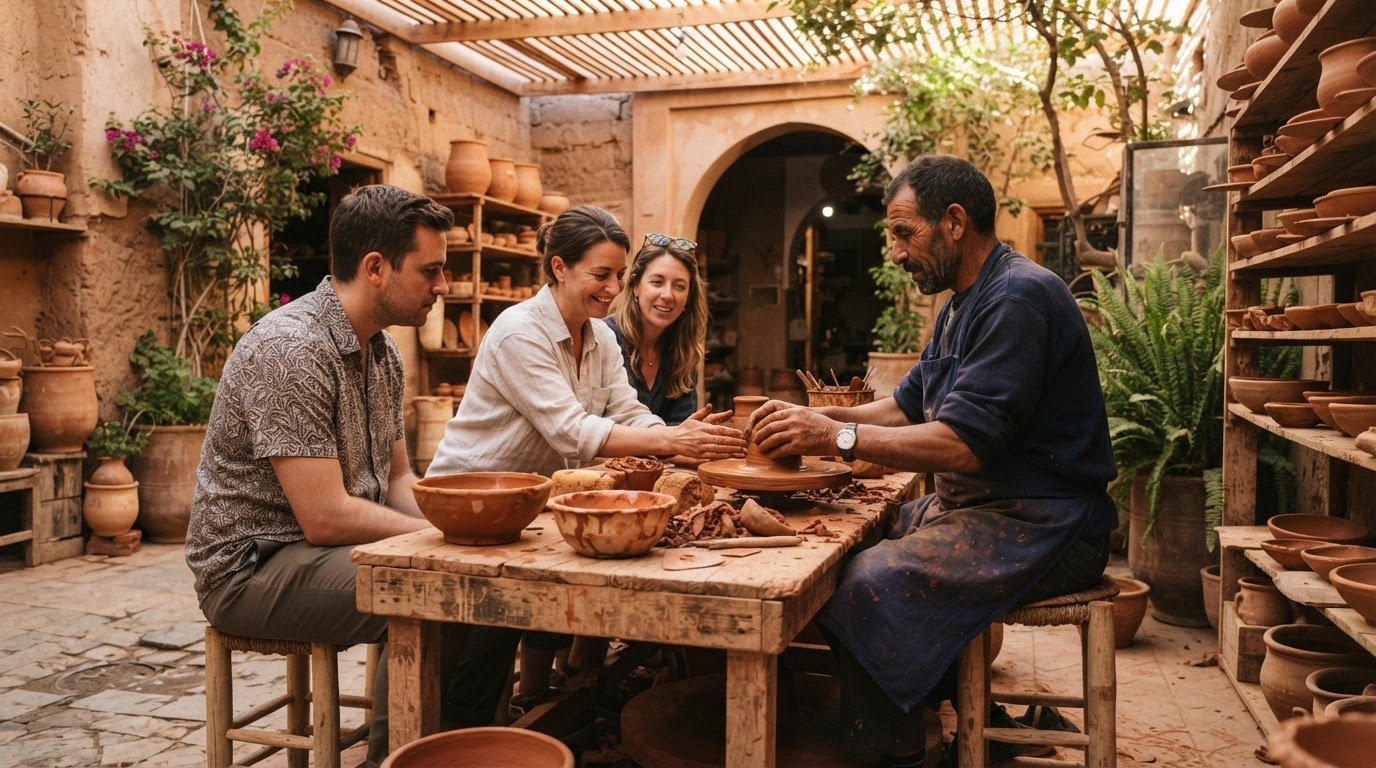
A Marrakech Workshop can be a cooking class, a pottery session, a leather bench, a weaving loom or a zellige tile table. The subject is almost secondary. What shapes your experience is the size of the group, the amount of time you actually touch the material, and whether the person teaching you works in that craft or simply performs it for visitors.
Two workshops with identical descriptions can feel completely different. One leaves you with clay under your fingernails and a genuine understanding of a technique. The other leaves you with a photo and a vague memory of watching someone else work. The criteria below are designed to help you spot which is which.
The Criteria That Actually Predict a Good Workshop
1. Hands-on time versus demo time
Ask directly how much of the session you spend working with your own hands. A cooking class where eight people share one chopping board is a demonstration with snacks. A pottery session where the instructor finishes your bowl for you is a souvenir shop with extra steps. A reasonable rule: at least half the session should be yours to make mistakes in.
2. Group size and language
Small groups mean attention. If the listing does not state a maximum, message and ask. Language matters too: if the class runs in three languages at once, instruction gets thin. A workshop run in one clear language, with patience for beginners, will always beat a multilingual performance.
3. Who is teaching
The best sessions are led by artisans who have spent years in the trade and by cooks who learned in a family kitchen rather than a hotel training programme. You do not need a celebrity name. You need someone who can explain why the clay is wedged a certain way, or why the onions go in before the spices.
4. What you take home
Some pieces need firing or drying and cannot travel with you the same day. A good organiser explains this upfront and offers a realistic solution: shipping, collection later, or a smaller piece you can carry. Vague answers here usually mean you leave empty-handed.
5. Price transparency
Check what is included: materials, apron, tea, transport, and whether a finished piece costs extra. A low headline price that grows with every add-on is not a bargain. Compare the total, not the entry fee.
Common Traps to Avoid When Booking
- The hotel-lobby package. Convenient, but often a diluted version of the real thing, with a fixed script and a large group.
- The too-short session. Ninety minutes rarely covers materials, technique and finishing. Two to three hours is a healthier minimum for most crafts.
- The photo-first workshop. If the description is mostly about photos of you in traditional dress, the craft is the backdrop, not the point.
- The invisible artisan. If no one names the workshop or the teacher, ask before paying.
- The packed schedule. Booking a workshop right after a long walking tour guarantees low energy and a rushed result.
- The unverified review. Read the middling reviews, not the glowing ones. They usually mention group size and hands-on time, which are exactly what you need to know.
Matching the Workshop to Your Trip
Think about where the session sits in your day. A cooking class works best when you are hungry and unhurried, ideally finishing with a shared meal. A pottery or zellige session suits a quieter morning, when your hands are steady and the medina is still waking up. Leather and weaving sessions reward patience and curiosity more than energy.
If you are travelling with children, confirm the minimum age and whether the tools are child-safe. If you are a solo traveller, a small group can be a pleasant way to spend an afternoon. And if you are combining crafts with other plans, our guide to the best things to do in Marrakech will help you avoid stacking two demanding activities on the same day.
It also helps to know how you will get there. A workshop deep in the medina may require a walk with a guide, while one on the edge of town is easier to reach by road. Factor in travel time before you commit to a start hour.
Questions Worth Sending Before You Book
- What is the maximum number of participants?
- How much of the session is hands-on, and what will I make myself?
- Are materials and tools included in the price?
- Can I take my piece home the same day, and if not, what are the options?
- Who teaches the session, and where does the workshop take place?
- What happens if I arrive late or need to cancel?
Clear, quick answers to these questions are a good sign. Hesitation or copy-paste replies are not. For a broader look at pairing a craft session with other cultural stops, see our ideas for a Marrakech Workshop and cultural experiences.
A Simple Checklist for Your Decision
Before you pay, run through five points: small group, majority hands-on time, a named artisan or cook, transparent extras, and a realistic take-home plan. If a workshop passes all five, book it. If it fails two or more, keep looking. There is no shortage of choice, and a little patience at the booking stage is the cheapest upgrade you will ever get.
Choose with these criteria and traps in mind, and your Marrakech Workshop becomes what it should be: a few hours spent learning something real from someone who does it well.
0 Comment