


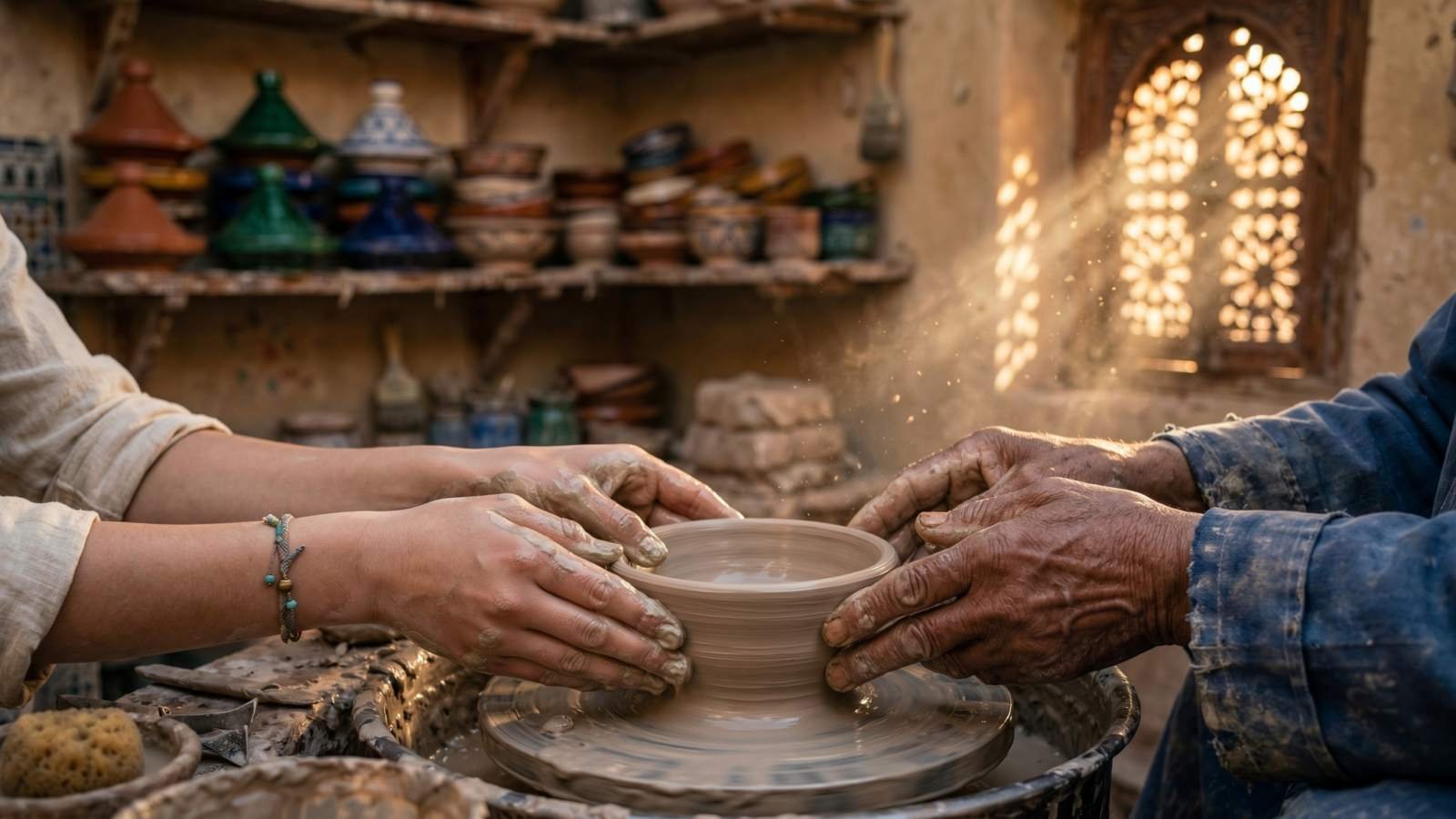

A Marrakech Workshop can be the highlight of a trip to the Red City — or a pleasant way to lose three hours in a room with bad lighting. The difference rarely comes down to luck. It comes down to the questions you ask yourself before you hand over your money. This is not a list of studios to visit. It is a short interrogation you should run on your own plans, honestly, before you commit.
At our Marrakech Workshop guide we hear the same stories from travelers: someone booked in a hurry, someone booked because a friend had done it, someone booked nothing and regretted it later. All three could have been avoided with five quiet minutes of self-questioning. Here is what to ask.
Before You Book a Marrakech Workshop, Ask What You Want to Carry Home
Before comparing prices or photos, decide what the object of the day is. A finished plate, a leather pouch, a folded rug, a memory of your hands covered in clay? Each answer points to a different kind of session.
- A tangible piece — pottery, zellige tilework, leatherwork. You leave with something solid and slightly imperfect.
- A skill — tagine cooking, bread baking, spice blending. You leave with a method you can repeat at home.
- A story — argan oil pressing, Berber rug weaving, a conversation with an artisan whose family has done this for generations.
- A feeling — the quiet of a courtyard workshop, hands busy, phone away.
If you cannot answer this one, stop here. Everything else is guesswork.
How Much Time Are You Really Willing to Give?
A workshop is not a museum visit you can walk through in twenty minutes. Real craft takes time, and sessions usually run from a short two-hour introduction to a full day at the bench.
Ask yourself: is this a filler between two other stops, or the main event of the day? If you have a tuk-tuk tour or a medina walk booked the same afternoon, choose the shorter format and say so when you book. Trying to squeeze a three-hour session into a ninety-minute gap ruins it for you and for the artisan.
Do You Want Your Hands Busy or Your Eyes Open?
Some travelers want to touch everything and leave with clay under their nails. Others prefer to watch, ask questions and photograph the process. Both are valid, but they are different products.
Ask directly: how much of the session is hands-on, and how much is demonstration? A good host will tell you without hesitation. If the answer is vague, that is information too.
Who Is Coming With You?
Traveling with children, with a partner who has zero interest in crafts, or with a friend who only wants to shop? Be realistic about the group.
Family-friendly sessions exist, but they are usually shorter, simpler and more forgiving. A serious zellige workshop with sharp tools is not the place for a bored seven-year-old. Ask whether the workshop welcomes children, and what they would actually do during the session.
What Is Your Budget, All In?
The headline price is rarely the whole story. Ask yourself what you are prepared to spend, then check what sits behind the number.
- Are materials included, or paid separately?
- Do you keep what you make, and is firing, glazing or finishing included?
- Is shipping home an extra cost, and how much?
- Is there a single supplement if you come alone?
Compare total cost, not sticker price. A cheaper session that charges extra for materials and delivery is often the more expensive choice.
How Will You Get There — and Back?
This sounds trivial until you are late. Many workshops sit deep in the medina, where a car cannot reach the door. Ask about the meeting point, whether someone walks you in, and how long the walk takes.
Build in a buffer. Fifteen minutes of margin turns a stressful arrival into a calm one. If you are coming from outside the center, plan the return leg too, especially in the evening.
What Language Will the Session Be In?
Most hosts work in several languages, but the depth of explanation varies. If you want to understand the history and technique, not just copy a motion, confirm that the session runs in a language you can follow comfortably. Ask who the instructor is and whether they teach themselves or hand you to an assistant.
What Happens If Plans Change?
Flights move. Children get tired. Ask about cancellation and rescheduling before you pay, not after. A clear, written policy is a sign of a well-run operation; a vague one is a warning.
The Answer You Are Looking For
If you can answer all these questions, you are ready. If several feel hard, that is not a reason to skip the experience — it is a reason to look at a Marrakech Workshop that is clearly described, fairly priced and run by people who answer questions willingly.
The best sessions are not the most photographed ones. They are the ones that match your time, your hands, your budget and your curiosity. Ask first. Then book. You will notice the difference the moment you sit down at the bench.
#MarrakechWorkshop #WorkshopMarrakech #ThingsToDoInMarrakech #MoroccanCrafts #ArtisanExperiences #CulturalExperiencesMarrakech #MoroccoPlan #AuthenticTravel
0 Comment